Powers of Ten
What It Is
This is a design exercise, reframing technique or ideation method that was used to create game concepts. It allows an intentional approach to considering the problem at varied magnitudes of framing.
Rules
All concepts must be based on assigning words or phrases to the powers of ten from 1 to 10,000.
Learnings
This exercise has helped immensely in planning for scale. The main lesson from this exercise was to understand the relationships between gameplay on the second to second level to the hourly cadence of rewards and flow and everything in between.
This exercise also helped understand that every small decision can have an impact on every part of the experience.
Examples
Swipe Fight Mobile Game
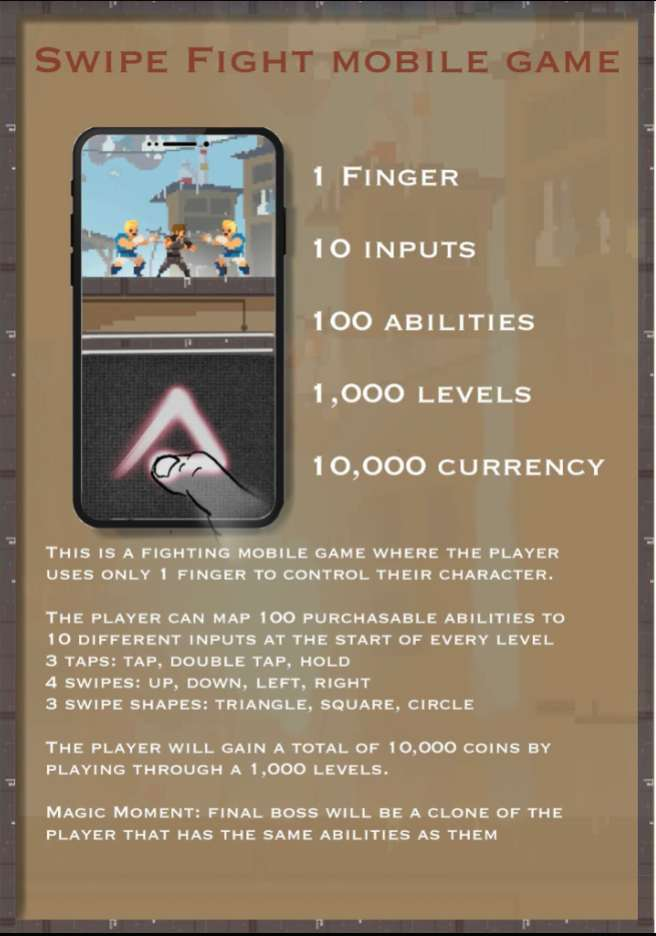
This is a fighting mobile game where the player uses only 1 finger to control their character.
The player can map 100 purchasable abilities to 10 different inputs at the start of every level — 3 taps (tap, double tap, hold), 4 swipes (up, down, left, right), and 3 swipe shapes (triangle, square, circle).
The player will gain a total of 10,000 coins by playing through 1,000 levels.
Magic Moment: final boss will be a clone of the player that has the same abilities as them.
Jigsaw Escape
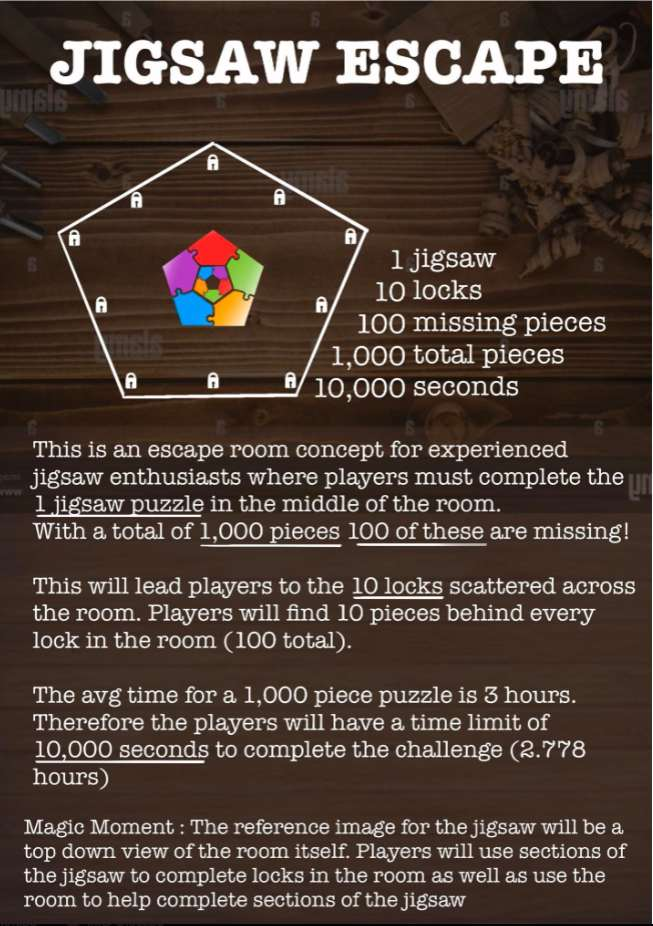
This is an escape room concept for experienced jigsaw enthusiasts where players must complete the 1 jigsaw puzzle in the middle of the room. With a total of 1,000 pieces, 100 of these are missing!
This will lead players to the 10 locks scattered across the room. Players will find 10 pieces behind every lock (100 total).
The avg time for a 1,000 piece puzzle is 3 hours. Therefore the players will have a time limit of 10,000 seconds to complete the challenge (2.778 hours).
Magic Moment: the reference image for the jigsaw will be a top down view of the room itself. Players will use sections of the jigsaw to complete locks in the room as well as use the room to help complete sections of the jigsaw.
NY Times Game Live Service Strategy
This concept isn't exactly for a game but more about creating a strategy for player engagement for a game that would fit the New York Times style game (especially the acquisition of Wordle). In this puzzle like game, (whatever it might be) the player will have a be given 100 puzzles a month – 3 on every weekday and 5 on each weekend day.
The player will get a total of 10 attempts to submit solutions across all the day's puzzles. They may choose to distribute these attempts however they like. They will also get the ability to skip a puzzle each week and auto complete it. They may choose to use this on any puzzle.
If this is widely accepted by players, puzzles will give players points for completing them. Only the first 10,000 players to complete each puzzle in the country will be awarded points. Winning points will contribute to the points total for your city, which will result in a leaderboard with the top 1000 cities. This creates a sense of competition between cities as well as teamwork for individual player's within the city.
Leaving a source of satisfaction for all types of players.